The 10 vendors the AI build-out actually pays, ranked on what they publish
Ten GPU clouds scored on the newest NVIDIA card they will let you book, whether they publish its price per GPU-hour, their capital band and NVIDIA's own equity. A published B200 hour runs $6.25 to $9.65.
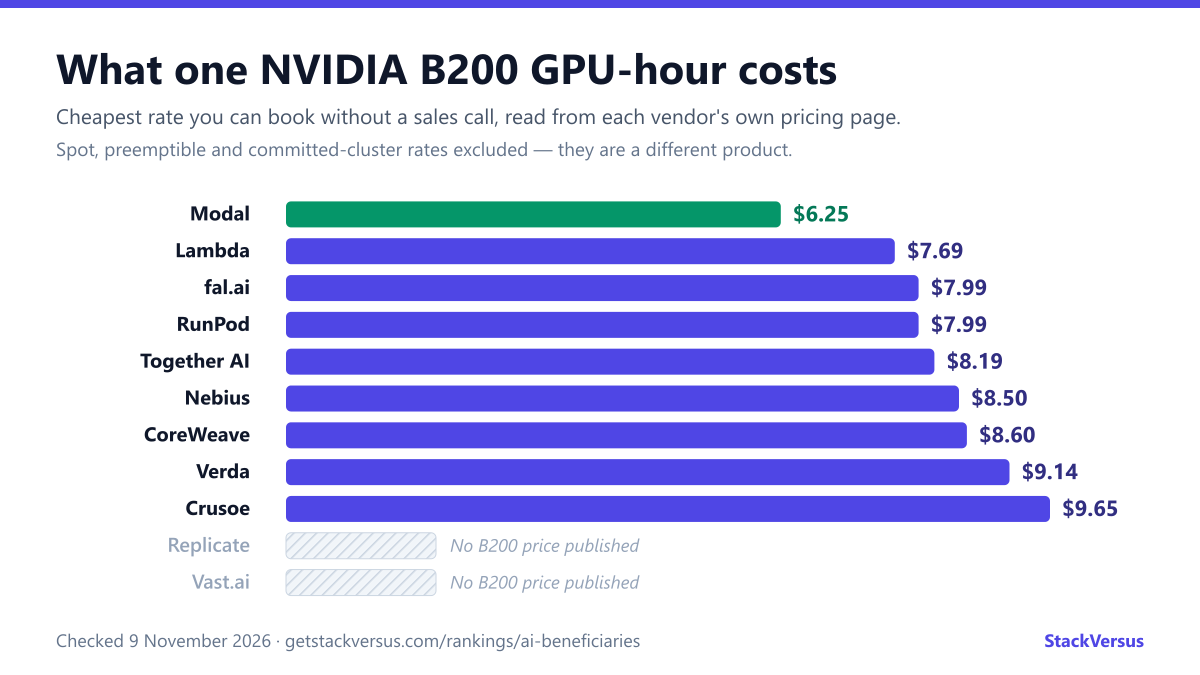
Ask the internet what an NVIDIA B200 costs for an hour and you get $3.00, $5.00, $5.83, $8.01 and $14.24. All five numbers are real. None of them is comparable to the others, because the trackers quoting them are mixing on-demand rates with spot capacity, community fleets, committed clusters and hyperscaler list prices, and mostly not saying which is which.
So we read the pricing pages instead. Eleven GPU clouds, on 9 November 2026, 63 price rows copied with the tier each one belongs to. The answer is narrower and more useful than the spread suggests: a published, on-demand-tier B200 GPU-hour costs between $6.25 and $9.65. That is a 1.5x spread, not a 4.7x one.
The full table, the per-vendor detail and the scoring are on the AI Beneficiary Rankings page. This piece is about what the numbers say.
What a B200 hour actually costs
Cheapest published rate first, each at its advertised tier:
| Vendor | Tier | Per GPU-hour |
|---|---|---|
| Modal | per second ($0.001736/s) | $6.25 |
| Lambda | on-demand, HGX B200 | $7.69 |
| fal.ai | list | $7.99 |
| RunPod | secure cloud | $7.99 |
| Lambda | on-demand, B200 SXM6 | $7.99 |
| Together AI | on-demand | $8.19 |
| Nebius | on-demand | $8.50 |
| CoreWeave | on-demand (derived) | $8.60 |
| Verda | on-demand | $9.14 |
| Crusoe | dedicated endpoint | $9.65 |
Two of those rows need an asterisk, and the asterisk is the point.
CoreWeave does not publish a per-GPU price at all. It publishes $68.80 an hour for an eight-GPU HGX B200 instance; the $8.60 is our division. Every tracker that prints “CoreWeave: $8.60” is doing the same arithmetic without telling you. And Lambda’s entire price list carries a line saying the rates take effect 16 November 2026 — so the numbers above are next week’s, and the current ones are behind a login.
Below the on-demand tier, the same card gets much cheaper and stops being the same product. Together AI publishes preemptible B200 at $4.09 and CoreWeave spot at $4.26. Nebius lists preemptible B300 “from $0.99” with a note that the rate can move every fifteen minutes. These are real prices for capacity that can be taken back mid-run. Quoting them as the price of a B200 is where “$3.00” comes from.
Two price rises nobody has written down yet
Crusoe’s self-serve table carries both its current and its next prices:
| Card | Now | From 1 Dec 2026 | Change |
|---|---|---|---|
| H100 (80GB HGX) | $5.50 | $6.30 | +15% |
| H200 (141GB HGX) | $6.00 | $7.50 | +25% |
| B200 (180GB HGX) | $9.65 | $10.20 | +6% |
| B300 (288GB HGX) | Contact sales | $13.80 | newly priced |
A 25% rise on H200 is the interesting one. The received wisdom is that last generation gets cheaper as the new one lands. Crusoe is raising Hopper prices by more than Blackwell prices, which is what happens when the older cards are the ones actually available and the new ones are allocated.
The ranking, and what it is scored on
Ten vendors is a list. What makes it a ranking is deciding what counts, so here is the whole formula, out of 10:
- Hardware, up to 3. The newest NVIDIA generation the vendor will actually let you book, by its own card names. Blackwell Ultra (B300/GB300) scores 3, Blackwell (B200/GB200) 2.25, Hopper (H200/H100) 1.5.
- Published price, up to 2. A per-GPU-hour rate on the page scores 2. A per-instance price you have to divide yourself scores 1.25. No list price at all scores 0.5.
- Capital, up to 3. In bands, not figures: listed public company 3, $20bn+ 2.5, $5-20bn 2, $1-5bn 1.25, undisclosed 0.75.
- NVIDIA’s own money, up to 2. A stake disclosed in an SEC filing scores 2. Named as an investor with no figure, 1.25. None disclosed, 0.5.
The capital component uses bands deliberately. The secondary reporting on these valuations conflicts — one source has fal.ai at $4.5bn and another at $1.5bn; CoreWeave’s NVIDIA stake is reported as both 11% and 9% — and a band survives that conflict where a precise figure would quietly launder one source’s guess into a fact.
The result:
| # | Vendor | Score | Newest bookable | NVIDIA equity |
|---|---|---|---|---|
| 1 | Nebius | 10.00 | Blackwell Ultra (HGX B300) | Disclosed stake |
| 2 | CoreWeave | 9.25 | Blackwell Ultra (B300 spot) | Disclosed stake |
| 3 | Crusoe | 8.75 | Blackwell Ultra (B300) | Named investor |
| 4= | Modal | 7.50 | Blackwell Ultra (B300) | None disclosed |
| 4= | Lambda | 7.50 | Blackwell (B200) | Named investor |
| 4= | Together AI | 7.50 | Blackwell (B200) | Named investor |
| 7= | fal.ai | 6.75 | Blackwell Ultra (B300) | None disclosed |
| 7= | RunPod | 6.75 | Blackwell Ultra (B300) | None disclosed |
| 9 | Verda (ex-DataCrunch) | 6.25 | Blackwell Ultra (GB300) | None disclosed |
| 10 | Replicate | 4.75 | Hopper (H200) | None disclosed |
Vast.ai finishes eleventh at 4.00, for a reason worth stating separately.
Nebius and CoreWeave are first because NVIDIA made them first
The two vendors at the top are the two where NVIDIA has disclosed equity. NVIDIA invested $2bn in Nebius in March 2026 and disclosed roughly a 9.3% stake in an SEC filing that July; it bought a further $2bn of CoreWeave shares in January 2026. CNBC put NVIDIA’s total equity investments at about $99bn as of September 2026.
That is not a coincidence the ranking stumbled into. A chip vendor that takes equity in its customers has told you which customers get allocation, and allocation is what decides whether a cloud can list a B300 at all. Nebius lists HGX B300 at $9.50 on demand and GB300 NVL72 as contact-sales; Replicate, with no NVIDIA equity and no disclosed 2026 round, lists no Blackwell card of any kind and charges $5.49 for both an H100 and an H200 hour — the same price for two different cards.
Crusoe is third on a different kind of strength: it raised over $3bn at roughly a $30bn valuation in September 2026, and it builds beside its own power generation. That makes it the one vendor here whose main constraint is energy policy rather than chip policy.
The cheap end is where the surprises are
Modal is cheapest on B200 and fourth overall, which is a strange combination until you look at how it sells. It bills per second — $0.001736 for a B200-second — with no cluster commitment, and it has no NVIDIA equity behind it. It is reported to have closed $750m at about a $15.75bn valuation in October 2026, after $355m at $4.65bn in May. A vendor that quadrupled its valuation twice in five months while undercutting the listed neoclouds on the newest card is the most interesting row in the table.
fal.ai does something almost no one else does: it publishes a GB200 per-GPU rate, $9.99 an hour. CoreWeave sells GB200 only as a $42.00 four-GPU instance; Nebius marks it contact-sales. If you want to know what a Grace-Blackwell hour costs without a sales call, there are two public answers, and fal.ai has one of them.
RunPod is the only vendor here that prices datacentre and consumer cards on the same page, which quietly answers a question people ask constantly. An RTX 4090 on its community fleet is $0.34 an hour. A B300 on its secure fleet is $8.99. That is 26x, for cards two generations and one market segment apart.
Vast.ai publishes nothing, and that is the finding
Vast.ai is a marketplace reselling GPUs across what it says are 40+ datacentres, and its pricing page contains no price. The B200 appears in the phrase “From RTX 3060 to B200”. GB200 appears in a banner. The only numbers are relative: interruptible is “50%+ cheaper”, reserved is “up to 50% off”, cheaper and off than what is not stated.
That is a legitimate way to run a marketplace where supply sets the rate. It also means nothing on that page can be compared with anything on this one without logging in, and any tracker that prints a Vast.ai figure got it from a live grid at a moment it did not record.
What this does not tell you
A high score is not a recommendation. It says a vendor is deep in the build-out — newest silicon, open prices, real capital, NVIDIA alongside — which is a statement about who the money is reaching, not about who should run your job. The cheapest published B200 hour belongs to a vendor in fourth place.
Three things in here are reported rather than filed, and are flagged as such on the ranking page: Modal’s and Together AI’s round sizes, Lambda’s reported $35bn Anthropic agreement and 2027 IPO plan, and the conflicting readings of NVIDIA’s CoreWeave stake. Policy is moving underneath all of it — the US shifted from presumption of denial to case-by-case review for advanced chips bound for China on 13 January 2026, and relaxed controls for the UAE that July — but no bill that would change allocation has become law, so none of it is scored.
The prices are the part you can act on, and they have a date on them. Lambda’s change lands on 16 November and Crusoe’s on 1 December. We will re-read the pages after both.
The Stack Brief
Get the weekly brief
One email a week: SaaS pricing changes, launches worth knowing about, and one comparison you can act on.
Sources
- Nebius prices (nebius.com)
- CoreWeave pricing (coreweave.com)
- Crusoe Cloud pricing (crusoe.ai)
- Modal pricing (modal.com)
- Lambda pricing (lambda.com)
- Together AI pricing (together.ai)
- fal.ai pricing (fal.ai)
- RunPod pricing (runpod.io)
- Verda pricing (verda.com)
- Replicate pricing (replicate.com)
- Vast.ai pricing (vast.ai)
- CNBC: NVIDIA's investments grow to $99 billion (cnbc.com)
- Bloomberg: Crusoe raises over $3 billion at $30 billion valuation (bloomberg.com)
- TechCrunch: Modal Labs closing in on $750M at $15.75B (techcrunch.com)
Related stories
beehiiv vs Mailchimp for newsletters in 2026: price, limits and monetization
beehiiv vs Mailchimp compared for newsletter publishers: price at 1k, 5k, 10k and 50k contacts, free plan limits, send caps and what each tool offers for earning money. Checked 6 Nov 2026.
Pham Cong6 min
beehiiv vs Substack in 2026: flat price or 10% of paid subscriptions?
beehiiv charges a monthly plan and takes 0% of paid subscriptions. Substack is free to start and keeps 10%. Fees, break-even revenue, ownership and growth tools compared, checked 6 Nov 2026.
Pham Cong6 min
Best newsletter platform to make money in 2026: beehiiv, Kit, Substack and Ghost compared
Fees, plan prices and monetization tools for beehiiv, Kit, Substack and Ghost, with a worked example of what each costs at 250 paying readers. Checked on the vendors own pages, 6 Nov 2026.
Pham Cong6 min
Comments
Join the discussion with your GitHub account. Be civil, stay on topic.