beehiiv vs Substack in 2026: flat price or 10% of paid subscriptions?
beehiiv charges a monthly plan and takes 0% of paid subscriptions. Substack is free to start and keeps 10%. Fees, break-even revenue, ownership and growth tools compared, checked 6 Nov 2026.
We earn a commission if you sign up through our links, at no cost to you.
The beehiiv vs Substack question is mostly a pricing-model question. Substack is free to publish on and takes a cut when readers pay. beehiiv charges a monthly fee based on your list size and takes nothing from paid subscriptions. Which one costs less depends on how much you earn and how big your list is. This comparison uses the vendors’ own pages, read on 6 November 2026. See also our beehiiv pricing breakdown.
The short version
| beehiiv | Substack | |
|---|---|---|
| Free plan | Up to 2,500 subscribers; no paid subscriptions | Publishing is free at any subscriber count |
| Cost to charge readers | Lite plan: $49/mo at 1,000 subscribers (yearly billing) | Nothing upfront |
| Cut of paid subscriptions | 0% from beehiiv | 10% of each payment |
| Payment processing | Stripe, 2.9% + $0.30 per transaction (per beehiiv’s FAQ) | Stripe: 2.9% + $0.30 per US card payment, plus 0.7% Stripe Billing |
| Ads | Ad monetization on paid plans | Not covered on the pages we checked |
| Custom domain | Not stated on the pricing page | One-time $50 |
| Email sends | Unlimited on every plan | No cap stated on the fee page |
How the fees work on Substack
Substack’s help center says publishing is free no matter how many subscribers you have. Turn on paid subscriptions and Substack keeps 10% of subscription revenue, and Stripe charges its own fees. The help page lists three charges: the 10% Substack fee, Stripe card processing at 2.9% + $0.30 per payment for US cards, and 0.7% for Stripe Billing on recurring payments. A custom domain is an optional one-time $50. Substack says it does not add a fee to web payments, though in-app purchases through the iOS app may cost readers more to cover Apple’s fees.
How the fees work on beehiiv
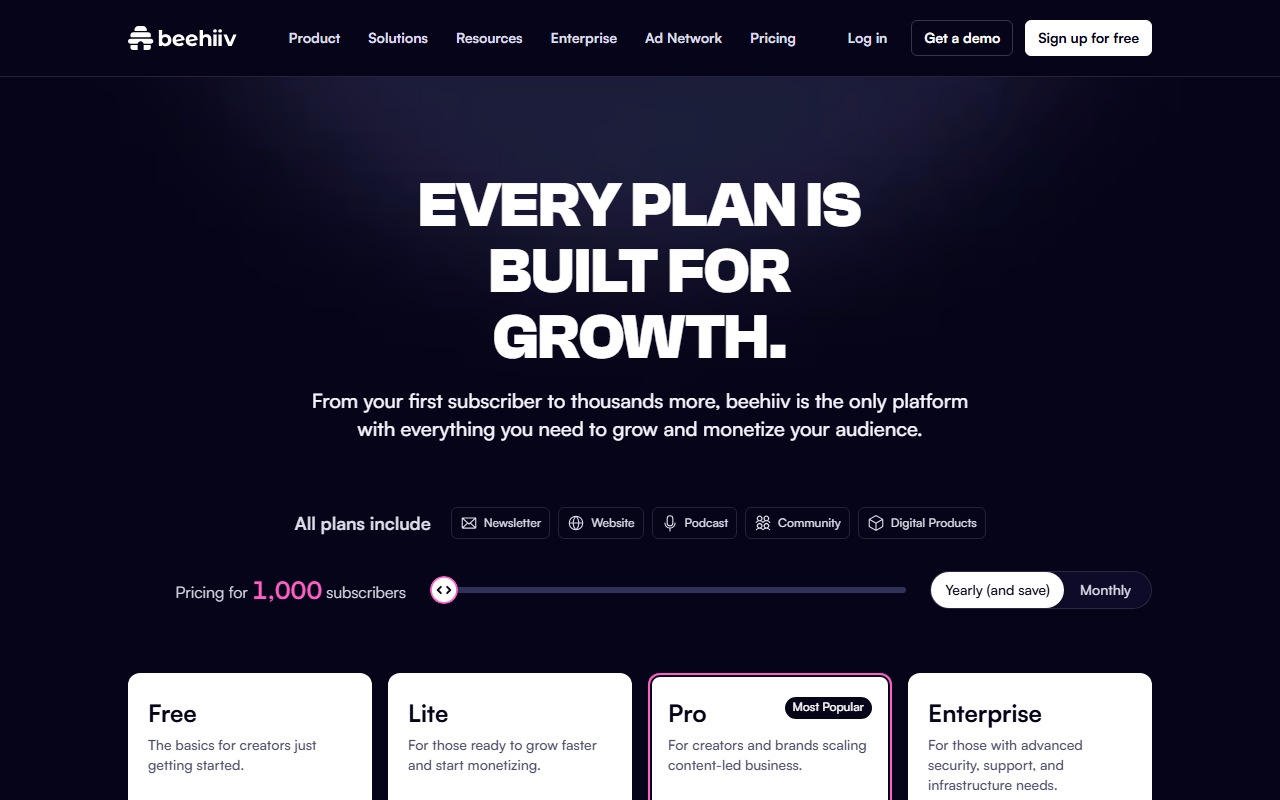
beehiiv’s pricing FAQ says it takes 0% of paid subscription and digital product revenue, and you keep what you earn minus Stripe’s standard fee of 2.9% + $0.30 per transaction. The price you pay is the plan. Paid subscriptions are listed under Lite, which at 1,000 subscribers is $49 a month on yearly billing or $59 monthly. The tier rises with list size: $119 at 10,000 subscribers and $249 at 50,000 (yearly billing).
What an $8 monthly subscriber is worth
Take one reader paying $8 a month on the web, using the published rates. Stripe’s per-transaction rate is 2.9% + $0.30 on both platforms. Substack also lists a 0.7% Stripe Billing charge. beehiiv’s pricing page does not list a billing charge, so any extra Stripe fee on that side is not covered here.
| Per $8 subscriber | beehiiv Lite | Substack |
|---|---|---|
| Platform cut | $0.00 | $0.80 |
| Stripe 2.9% + $0.30 | $0.53 | $0.53 |
| Stripe Billing 0.7% | not listed | $0.06 |
| You keep (approx.) | $7.47 | $6.61 |
| Effective fees | about 6.6% | about 17.4% |
The rounded figures above come from our arithmetic on the published rates; they are not a number either vendor quotes.
Break-even: when beehiiv gets cheaper
Because Substack takes 10%, the point where a flat plan wins is the plan price divided by 0.10. This compares platform fees only and ignores Stripe, which both charge.
| Your list | beehiiv Lite (yearly billing) | Substack fee equals Lite at |
|---|---|---|
| 1,000 subscribers | $49/mo | $490/mo in paid revenue |
| 10,000 subscribers | $119/mo | $1,190/mo |
| 50,000 subscribers | $249/mo | $2,490/mo |
Example: a newsletter with 10,000 subscribers and 500 paying $8 a month grosses $4,000 a month. Substack’s cut is $400. beehiiv Lite at that list size is $119. That is $281 a month, or $3,372 a year, in favor of beehiiv before Stripe fees and before any ad income. If only 40 readers pay $8, gross revenue is $320, Substack’s cut is $32, and beehiiv at 10,000 subscribers still costs $119. Substack wins there.
Growth and discovery
Substack’s strongest argument is its network. Its about page says more than half of new subscribers come from Substack’s built-in network, and that 30% or more of paid subscriptions come from within the network. It also reports 5 million paid subscriptions on the platform. These are Substack’s own claims and describe the platform average, not what a new publication will see. If you have no audience yet, a reader network that recommends writers is a real advantage that beehiiv’s pricing page does not match with a comparable figure.
beehiiv lists a recommendation network on every plan, including Free, plus A/B testing and polls from Lite. It does not publish a reader-discovery number comparable to Substack’s, so we cannot compare the size of the two networks.
Ownership and leaving
Substack’s about page describes the platform as free to start and free to leave, and its help center has an Exports setting for posts, subscriber list and related statistics. Substack also publishes a guide for moving from beehiiv, which says to start with Settings and Export Data in beehiiv. We did not find a beehiiv page on exporting that we could verify today, so confirm the steps in beehiiv’s help center before you commit. Paid subscribers are the harder part of any move, so read each vendor’s migration guide for how they carry over.
If you are leaning toward a flat fee, you can see beehiiv’s price for your list size before doing the sums above.
Who should pick which
Pick Substack if:
- You want to start for free and only pay when readers pay you.
- Your audience is likely to come from discovery inside Substack rather than from your own channels.
- You expect modest paid revenue, below the break-even figures above.
Pick beehiiv if:
- You expect to charge readers or sell sponsorships at a scale where 10% of revenue is more than a monthly plan.
- You want ad monetization, automations and polls inside the same tool (paid plans).
Pick neither if your list is above 2,500, you do not plan to charge, and cost matters most. In that case Kit’s free plan covers up to 10,000 subscribers; see beehiiv vs Kit (ConvertKit).
Where beehiiv is worse
- You must pay before you can charge readers. Paid subscriptions are not on the free plan.
- The monthly price grows with list size even if your revenue does not.
- Its pricing page does not publish a discovery or network figure comparable to Substack’s.
Verdict
For a new writer with no audience and no certainty of earning, Substack’s no-upfront-cost model and network are hard to beat. For a writer who already has readers and expects to earn more than a few hundred dollars a month from subscriptions, a flat fee saves real money. You can try beehiiv free and test the editor and recommendation tools before deciding, since the free plan has no card requirement and no time limit. If you are weighing more options, read our best newsletter platform to make money in 2026 guide, then check beehiiv’s current prices with the live plan slider.
In this story


Compare the tools in this story

The Stack Brief
Get the weekly brief
One email a week: SaaS pricing changes, launches worth knowing about, and one comparison you can act on.
Sources
Related stories
Best newsletter platform to make money in 2026: beehiiv, Kit, Substack and Ghost compared
Fees, plan prices and monetization tools for beehiiv, Kit, Substack and Ghost, with a worked example of what each costs at 250 paying readers. Checked on the vendors own pages, 6 Nov 2026.
Pham Cong6 min
beehiiv pricing 2026: every plan, subscriber limits and what it costs at 1k, 10k and 50k
beehiiv has four plans: Free (up to 2,500 subscribers), Lite from $49, Pro from $95 and Enterprise. Full price table by list size, monthly vs yearly billing and what each tier unlocks, checked 6 Nov 2026.
Pham Cong6 min
The Stack Brief: newsletter platforms tilt toward creators, and the automation price war heats up
This week: how Kit and Beehiiv are pricing the newsletter market differently, why per-execution billing is the automation story to watch, and one comparison worth your time.
Pham Cong2 min
Comments
Join the discussion with your GitHub account. Be civil, stay on topic.